
Using an e bike for delivery riders‘ daily work sounds like free money at first: no petrol, tiny charging cost, more of every rupee earned staying in your pocket. Food and parcel riders in Pakistan routinely cover 100–150 km a day, though, and that is a workload most commuter e-bikes were never designed for. The honest answer is that an e-bike can work very well for some delivery patterns and badly for others — this guide separates the two, with the range, charging and earnings math laid out plainly, including for riders thinking of using a government scheme bike.
The Delivery Day, Measured in Kilometres
A petrol delivery bike drinks fuel but refills in two minutes, anywhere. An e-bike’s limit is its battery: a typical commuter model honestly delivers 60–85 km per charge, and a charge takes hours, not minutes. So the real question is not “can an e-bike do delivery?” but “what shape is your delivery day?”
- Part-time or evening rider (40–70 km/day): one charge covers the shift. An e-bike fits perfectly and the fuel saving is almost pure gain.
- Zone-based full-time rider (80–120 km/day): workable with planning — a midday top-up charge at home, a restaurant base or a swap arrangement, and choosing orders inside a tight zone.
- City-wide full-time rider (130 km+/day, no fixed base): the hardest case. Without a second battery or a genuinely long-range model, downtime will eat the fuel saving in lost orders.
The Earnings Math: Fuel Saved vs Orders Lost
| Daily figure (example) | Petrol bike | E-bike |
|---|---|---|
| Distance | 120 km | 120 km |
| Fuel / charging cost | ~Rs 650–750 (petrol) | ~Rs 130–200 (electricity) |
| Oil & engine care share | ~Rs 100–150 | Minimal |
| Charging downtime | None | 1 break of 1.5–3 hrs (or battery swap) |
| Running cost per day | ~Rs 750–900 | ~Rs 150–250 |
The saving in this example — around Rs 500–650 a working day, or roughly Rs 13,000–17,000 a month — is large enough to matter enormously to a rider. But it is only real if the downtime does not cost more than that in missed peak-hour orders. Lunch and dinner peaks are when riders earn fastest; a battery that dies at 7 pm is far more expensive than one that rests at 3 pm. Successful e-bike delivery riders organise the day around that fact: full charge for the lunch peak, top-up during the quiet afternoon, full again for dinner. Current petrol prices used in comparisons like this follow the official rates published under OGRA, so update the example whenever prices change.
E Bike for Delivery Riders: Charging Strategies That Work
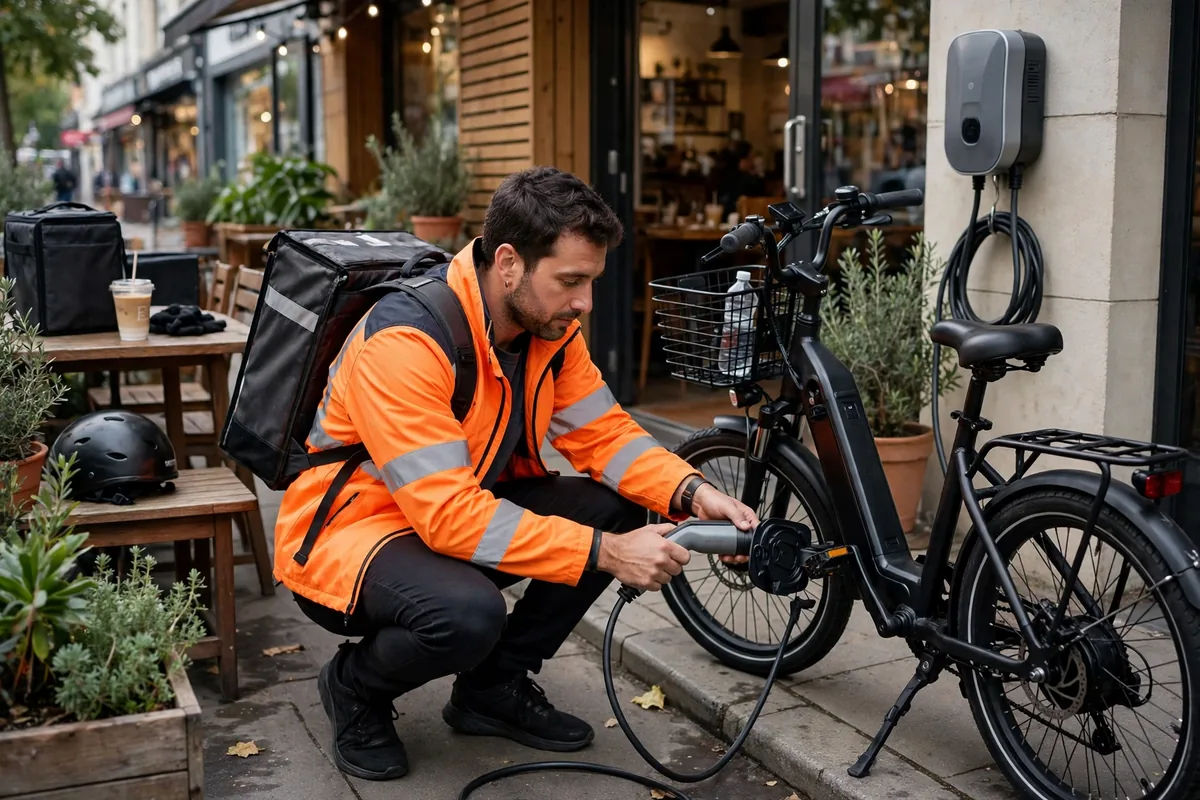
- A second battery is the professional solution where the model allows swapping: one charges while one works, and range stops being a daily worry. Price the second pack before buying the bike, because it is a serious extra cost.
- A home-base pattern: riders who live inside their delivery zone can plug in during the afternoon break at home — even 90 minutes returns a useful share of range.
- A big-battery model from the start: choosing a 30Ah-class pack over the standard size costs more upfront but can remove the midday charge entirely for medium-distance riders.
- Employer and restaurant goodwill: some riders arrange a socket at a regular restaurant or market shop for the break hour; always ask permission and never overload a shop’s wiring.
Road safety matters as much as range for riders working all day in traffic; the National Highway & Motorway Police safety guidance applies to delivery riding as much as to any road user — a helmet and a maintained bike protect your income as well as your health.
Can You Use a Scheme Bike for Delivery Work?
This needs a careful, honest answer. Government e-bike schemes in Pakistan are announced for defined categories — students and teachers are the main ones — and the financed bikes come with terms set by the scheme and the bank. Using a student-scheme bike as a full-time delivery vehicle can conflict with the category purpose and the financing terms, and heavy commercial use also wears the bike and battery far faster than the installment plan assumes. Part-time delivery alongside your studies is a greyer area that riders discuss often, but the safe course is to read your scheme agreement and ask through the official channel before building an income plan on the bike. Applicants can review the categories on the E Bike Scheme for Teachers and student pages of this site to see who each scheme is actually for.
If delivery is your main job, the cleaner path is usually a self-purchased or bank-financed e-bike bought for that purpose — the Bank of Punjab E-Bike Scheme page explains how the financing side works — with a battery sized for work from day one.
Load, Comfort and Durability for Work Riding
Delivery is hard use: a loaded box, a passenger-weight of parcels on some runs, kerbs, and all-weather riding. Check the bike’s rated load capacity and stay inside it, keep tyre pressure correct for load, service brakes more often than a commuter would, and budget for tyres and brake parts as business costs. Comfort is an earning factor too — a seat and suspension you can tolerate for six hours protect your back and your concentration.
FAQs
How many deliveries can an e-bike realistically do in a day?
In a compact zone with a midday top-up, most riders can cover a normal part-time to full-time order load. The limit is your zone’s distance and your charging pattern, not the number of orders itself.
Is a second battery worth the money for a rider?
For full-time riders, usually yes: it converts charging downtime into working time every single day, and the packs pay for themselves through the petrol saving. For part-time riders, one battery is normally enough.
Will delivery use damage the battery quickly?
Deep daily discharges and fast charging do shorten battery life. Shallower cycles, an afternoon top-up instead of a full drain, and slow charging wherever possible all extend the pack’s working years.
Can I legally use my student scheme bike for food delivery?
Scheme and financing terms govern this, and full-time commercial use can conflict with them. Read your agreement and ask the scheme’s official channel; do not rely on social media opinions for a financed bike.
What range should a delivery rider buy?
Size for your longest day, not your average: if you ride 120 km on busy days, look for an honest 100 km+ per charge or plan a confirmed midday charge or second battery.
Conclusion
An e bike for delivery riders is a genuine money-saver when the work pattern fits the battery: part-time shifts, compact zones and a reliable midday charge. It struggles only when long, unplanned days meet a small pack and no charging base. Price the second battery, plan the charging break around the afternoon lull, respect your scheme terms if the bike is financed — and the petrol saving becomes income you actually keep.