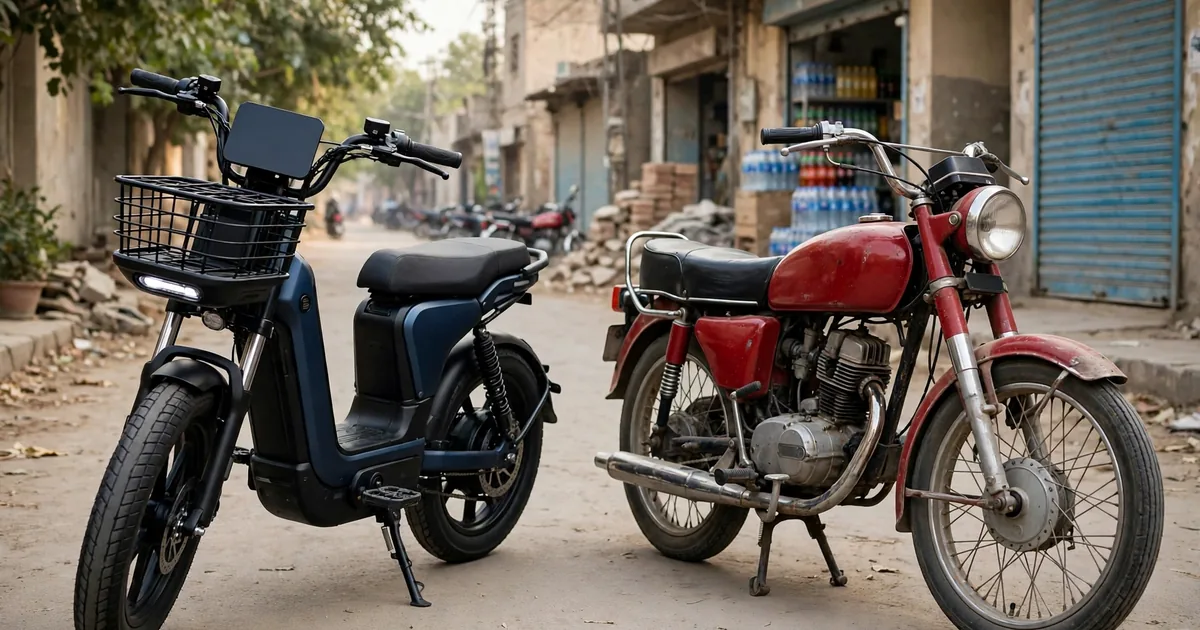
The e bike vs 70cc bike debate is the real decision facing most Pakistani commuters in 2026, because the 70cc has been the country’s default daily transport for decades: cheap, familiar, and repairable in every street. An e-bike challenges it on exactly the ground the 70cc owns — daily travel cost and convenience. This comparison is deliberately honest about both: where the newcomer genuinely wins, where the old champion still holds its ground, and how your own daily pattern should decide it.
Figures below are examples for planning. Fuel prices, electricity tariffs and showroom prices change often in Pakistan — refresh the numbers with current rates before deciding.
The Side-by-Side Every Buyer Asks For
| Daily-travel factor | E-bike (commuter class) | 70cc petrol bike |
|---|---|---|
| Running cost per km | ~Rs 1.3–1.7 (home charging) | ~Rs 5–6 (petrol, real city average) |
| Monthly cost at ~1,000 km | ~Rs 2,000–3,700 all-in | ~Rs 6,500–8,500 all-in |
| Refuel / recharge | 5–7 hours at home | 2 minutes at any pump |
| Daily range confidence | 60–85 km per charge, plan around it | 200+ km per tank, go anywhere |
| Maintenance routine | Tyres, brakes, connectors | Oil, tuning, filters, plugs, clutch |
| Ride feel | Silent, smooth, instant pull | Familiar engine feel, vibration |
| Repair network | Growing, city-focused | Every town and street corner |
| Long-distance trips | Limited by charging | Easy with fuel stops |
Read the table as two different strengths: the e-bike wins the costs you pay every day; the 70cc wins the freedoms you need occasionally — instant refuelling, unlimited range and a mechanic everywhere. Which column matters more depends entirely on how your weeks actually look.
One more everyday factor deserves a place in the margins of that table: summer traffic. A petrol bike throws engine heat at your legs at every signal from May to September, while an e-bike produces almost none at a standstill — a small mercy you feel twice a day. Against that, the 70cc’s engine braking and familiar throttle response on open roads still feel natural to experienced riders, and many older riders trust what their hands already know. Habits are a real cost of switching too, in both directions.
Where the E-Bike Wins for Daily Travel
For a fixed daily pattern — home to office, campus or shop and back — the e-bike’s advantages stack up quickly. The fuel saving is the obvious one, often Rs 4,000–5,000 a month at typical commuting distances, and it arrives every month without effort. The ride itself is calmer: no engine vibration at signals, no gear-and-clutch work in crawling traffic on the common automatic-style models, and near-silent running that makes early-morning departures kinder to the whole house. Maintenance shrinks to a short list, which suits owners who never enjoyed workshop visits. And if you qualify, a scheme route such as the CM Punjab E Bike Scheme can put the e-bike in your hands on installments sized against exactly these monthly savings.
Where the 70cc Still Wins — Honestly
The 70cc’s case rests on flexibility, and it is a strong case for many riders. If your work takes you to unpredictable places — field visits, intercity runs, a village on weekends — petrol’s two-minute refill and Pakistan’s unmatched mechanic network remove all range planning. A used 70cc can also be bought for a low entry price that no new e-bike matches today, and its resale market is deep and instant in every city; used-bike listings on platforms like PakWheels show how liquid that market is. Riders without reliable home charging — some hostel, plaza and rented setups — also find the 70cc simply fits their living situation better for now.
The hidden question: your parking spot
Daily-travel comparisons rarely mention the deciding practical factor: where the bike sleeps. An e-bike needs a socket within reach of its parking place most nights. A ground-floor home with a porch point makes e-bike life effortless; a third-floor flat with street parking makes it a daily negotiation. Answer this question honestly before the cost table seduces you either way.
E Bike vs 70cc Bike for Different Riders
- Student, fixed campus route, home charging: e-bike, clearly — lowest monthly cost exactly when money is tightest.
- Office commuter, 25–50 km daily round trip: e-bike, with range to spare on a mid-size battery.
- Sales or field worker, changing locations daily: 70cc, unless your territory is one compact zone.
- Family’s only vehicle, weekend village trips included: 70cc today, or an e-bike plus a plan for those trips.
- Second household vehicle for local errands: e-bike — short trips are its home ground.
Teachers weighing a scheme offer against keeping their 70cc can see the category-specific financing on the E Bike Scheme for Teachers page and run the same comparison with their real commute.
FAQs
Is an e-bike really cheaper than a 70cc for daily use?
For regular daily distances, yes — typically by several thousand rupees a month in fuel and maintenance, even after allowing for a future battery replacement. The less you ride, the smaller the advantage.
Can an e-bike replace a 70cc for a 60 km daily commute?
Yes, with a model honestly rated above that distance per charge, so you are not emptying the battery fully each day. Confirm your route fits with margin before buying.
Which is more reliable day to day?
Both are dependable when maintained. The e-bike has far fewer moving and wearing parts, so there is less to go wrong; the 70cc has the unbeatable advantage that any fault can be fixed almost anywhere, immediately.
What about riding with a passenger?
Both handle a passenger; on the e-bike, expect range to drop noticeably with the extra weight, so size the battery for two-up days if they are your routine, not the exception.
Will a 70cc hold its value better than an e-bike?
Today, generally yes — the 70cc resale market is mature and instant. E-bike resale is improving as the fleet grows, and bikes with documented battery health sell noticeably better than those without records.
Conclusion
There is no universal winner in e bike vs 70cc bike — there is a winner for your pattern. Fixed daily route plus home charging plus regular kilometres: the e-bike takes it on cost, calm and upkeep. Unpredictable distances, no charging point, or a rock-bottom purchase budget: the faithful 70cc still earns its place. Decide by your diary and your parking spot, not by the loudest opinion in the market.