
The e bike range per charge printed in advertisements is almost never the range you will get on your daily route — and that gap disappoints more new owners than any other single thing. A claim like “up to 100 km” is measured under gentle test conditions: a light rider, flat road, steady low speed, no stops. Your real commute has traffic, a pillion passenger, headwinds, summer heat and a hurry-up right hand on the throttle. Understanding the gap lets you plan your day instead of pushing your bike home.
This guide explains what decides real-world range in Pakistan, how to estimate yours honestly, and the riding habits that stretch every charge further.
What Decides Your Real E Bike Range Per Charge
Range is simply battery energy divided by how fast you spend it. Everything below changes one side of that equation:
- Battery size (capacity): bigger capacity, usually expressed in amp-hours or watt-hours, means more stored energy and more range.
- Speed: air resistance rises sharply with speed. Cruising gently can use dramatically less energy per kilometre than riding flat-out.
- Weight: rider, pillion and luggage all cost energy, especially on slopes and in stop-start traffic.
- Stops and acceleration: every full-throttle start from a signal spends a burst of energy that gentle riding avoids.
- Tyre pressure and condition: soft tyres drag. Correct pressure is free range that many riders throw away.
- Temperature: very hot days and cold winter mornings both slightly reduce what a battery delivers, for different chemical reasons.
- Battery age and care: an ageing or poorly kept pack stores less than it did when new.
Reading the company claim correctly
Treat the printed range as a maximum under ideal conditions. A reasonable planning habit is to expect noticeably less in mixed city use — how much less depends on your weight, speed and route. If your daily round trip is close to the claimed figure, the bike is the wrong size for you, whatever the brochure says.
Typical Ranges: Claim vs Road
The table gives general illustrations for common classes of e-bikes sold in Pakistan. Your model’s manual and your own log will always beat a general table:
| Bike style | Typical claim | Realistic mixed city use | Best for |
|---|---|---|---|
| Small commuter / scooter style | Short local range | Enough for campus, office and market trips | Short daily rounds under ~15–20 km |
| Mid-size commuter bike | Mid-range claim | Comfortable for most full-day city use | Daily rounds of ~20–40 km |
| Large battery / long-range model | Highest claims in the market | Handles long inter-city style commutes with margin | Daily rounds above ~40 km |
If your institute commute is the main job, match the bike to that distance first — the E Bike Scheme for Students page covers how student riders use these bikes day to day, and teachers comparing commute distances can see the E Bike Scheme for Teachers page for their category’s usage pattern.
How to Measure Your Own Real Range
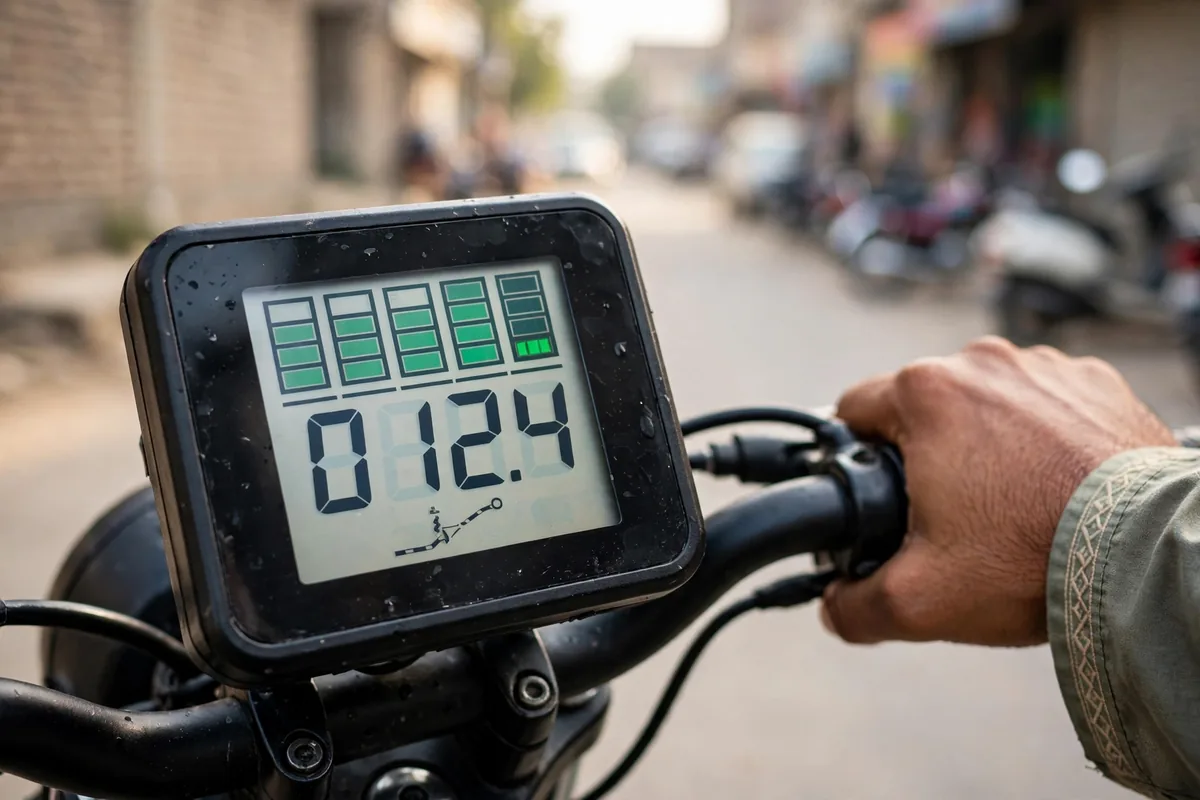
- Charge fully, note the trip meter or reset it.
- Ride your normal week — same route, same load, your usual speed — rather than a special gentle test.
- Note the distance covered when the battery reaches the low level you are comfortable with (do not drain a lithium pack to absolute zero just for a test).
- Repeat once more and average the two results. That average, minus a safety margin, is your planning range.
Keep a tiny monthly log. A slow fall in the number is normal ageing; a sudden fall is a warning to check tyre pressure, brakes dragging, and battery health, in that order. Background information on electric vehicle performance is also published by Pakistan’s Alternative Energy Development Board at aedb.org.
Route Planning: The Hidden Range Factor
Two riders with identical bikes and identical distances can finish the day with very different battery levels purely because of their routes. A slightly longer road with steady flow often uses less energy than a shorter route through a choked bazaar, because the battery pays for every stop and every hard restart, not just for kilometres. Flyovers and slopes charge their own toll, while a route with a long, gentle cruise at moderate speed is the cheapest travel an e-bike knows.
Experiment for one week: ride your normal route, then try the calm alternative, and compare the battery level on arrival. Most riders find a favourite that saves both charge and temper. It is also worth learning where you could take a short opportunity charge along your day — an institute parking point, a workplace socket with permission — because a small midday top-up effectively enlarges your battery for the price of a little planning.
Riding Habits That Stretch Range
- Accelerate gently and hold a steady, moderate speed instead of sprint-and-brake riding.
- Keep tyres at the recommended pressure — check weekly; it takes two minutes.
- Coast to stops where safe: release the throttle early instead of braking late.
- Carry less: a heavy bag on your back is fine, but avoid turning the bike into a daily cargo vehicle if range is tight.
- Plan charging into the day: a short top-up at the institute or office, where allowed, converts a borderline commute into a comfortable one — plan around typical charging times rather than guessing.
FAQs
Why is my range less than the advertised figure?
Because the advertised figure is a best-case test result. Rider weight, speed, stops, pillion load, tyre pressure and heat all reduce real range. Measure your own range over a normal week and plan around that number.
Does carrying a passenger reduce range a lot?
Yes, noticeably. Extra weight costs the most in stop-start traffic and on slopes. If you regularly carry a pillion, choose a model with range margin above your daily distance.
Will my range fall as the battery gets older?
Gradually, yes — all rechargeable batteries lose some capacity with age and use. Good charging and storage habits slow the decline; a sudden drop is different and should be checked.
Does using the headlight or phone charger reduce range?
Slightly, but these loads are small compared with the motor. Speed and weight choices matter far more than accessories.
What range do I need for a student commute?
Add your full daily round trip, then add a comfortable margin for detours and a weakening battery. If the total is anywhere near the claimed range, step up to the next battery size.
Conclusion
Your e bike range per charge is not a fixed number printed in a brochure — it is a result of your battery, your route, your load and your right hand. Measure it honestly over a real week, ride gently, keep the tyres hard and the battery cared for, and range anxiety disappears from your daily commute.