Getting e bike motor power explained properly saves buyers from the two classic mistakes: paying extra for a 2000W motor they never needed, or buying a gentle 1000W bike for a hilly, two-rider commute it cannot handle happily. Watts are printed bigger than any other number in e-bike advertising, yet a watt rating alone tells you surprisingly little about how a bike will feel on Pakistani roads. This guide explains what motor power actually changes — pickup, hill climbing, carrying load, top speed and range — so you can pick the right size for your real riding.
What a Watt Rating Really Means
A motor’s watt rating describes how much electrical power it is designed to draw and convert into motion. A 1000W motor can pull roughly twice the power of a 500W one, which generally means stronger acceleration and better ability to hold speed against resistance — wind, slopes and weight. But the number on the sticker is not the whole story. Two motors with the same rating can feel different because of the controller’s settings, the battery’s ability to deliver current, and whether the rating quoted is the continuous (rated) power or a short peak figure used for advertising.
There is also a legal and practical frame: government scheme bikes and mainstream commuter models in Pakistan cluster in the 1000W–2000W band, and national EV policy discussions tracked by bodies such as NEPRA and the energy conservation authorities treat these as full road motorcycles, not bicycles. Whichever size you choose, it needs the licence and registration a motorcycle requires.
1000W vs 1500W vs 2000W: The Honest Comparison
| Motor | Feels like | Best suited to | Range effect |
|---|---|---|---|
| 1000W | Gentle, calm pickup; content at city speeds | Solo rider, flat city routes, students | Longest range from a given battery |
| 1500W | Noticeably stronger pull; confident with a passenger | Daily commuters, mixed routes, some slopes | Moderate; drains battery faster at full use |
| 2000W | Strong acceleration; holds speed on inclines and flyovers | Heavier riders, hilly areas, delivery work | Shortest range unless battery is also bigger |
Top speeds differ less than the advertising suggests. All three classes typically sit in a commuter speed band suitable for city roads — the bigger motor mainly gets you to that speed faster and keeps you there when the road tilts up or a second rider climbs on. If your route is flat Lahore or Karachi city riding with one rider, a 1000W bike already does the complete job.
E Bike Motor Power Explained Through Four Real Situations
1. Pulling away at a signal
Torque is what you feel in the first three seconds. Higher-watt motors, paired with a controller that allows it, pull away more eagerly. In dense traffic this feels safer because you clear the junction briskly instead of wobbling away slowly.
2. Flyovers, ramps and hilly towns
On the flat, weight hardly matters; on a slope, everything matters. A 1000W bike with a heavy rider can slow noticeably on a long flyover ramp, while a 1500W or 2000W bike holds its pace. Riders in Islamabad’s slopes, Murree-road commutes or Karachi’s flyovers should size up one class.
3. Carrying a passenger or load
Two riders can double the demand on the motor at low speed. If your daily pattern includes dropping a sibling, a spouse or delivery loads, the middle 1500W class is the sensible minimum, and it is also the class many scheme commuter models use. You can see which models are being offered to applicants on the main E Bike Scheme page.
4. Range from the same battery
Power and range pull in opposite directions. Ridden at full demand, a 2000W motor empties a battery roughly twice as fast as a 1000W one. This is why long-range models pair bigger motors with bigger batteries — when comparing two bikes, judge motor and battery together, never the watts alone.
Don’t Forget the Controller and Battery
The controller is the motor’s manager: it decides how much current the battery may deliver, and a conservatively set controller can make a “2000W” bike feel tame, while a well-matched 1200W setup feels lively. Similarly, a battery with a low discharge rating cannot feed a big motor properly, whatever the sticker says. In the showroom, ask three questions: is the quoted wattage rated or peak, what controller rating is fitted, and what is the battery’s capacity in watt-hours (volts × amp-hours)? A seller who answers all three clearly is a seller you can trust with the bigger questions too — a good standard to apply when comparing offers such as those under the Federal E Bike Scheme.
FAQs
Is a 2000W e-bike always faster than a 1000W one?
Not always in top speed, which is often limited similarly across commuter models. The 2000W bike accelerates harder and holds speed better on slopes and with load; on flat solo rides the difference feels smaller.
Does a bigger motor use more electricity per kilometre?
Only when you use the extra power. Ridden at the same gentle pace, consumption is similar; ridden at full acceleration and speed, a bigger motor draws more and shortens range.
Which motor size is best for a student?
For a solo student on flat city routes, 1000W–1500W is the sweet spot: enough pull for traffic, the friendliest range, and usually the lowest price and battery replacement cost.
Can I upgrade my motor later for more power?
It is rarely practical. A bigger motor usually needs a matching controller and a battery that can feed it, so the upgrade costs approach a bike change. Buy the right class the first time.
How can I tell if the watt rating is honest?
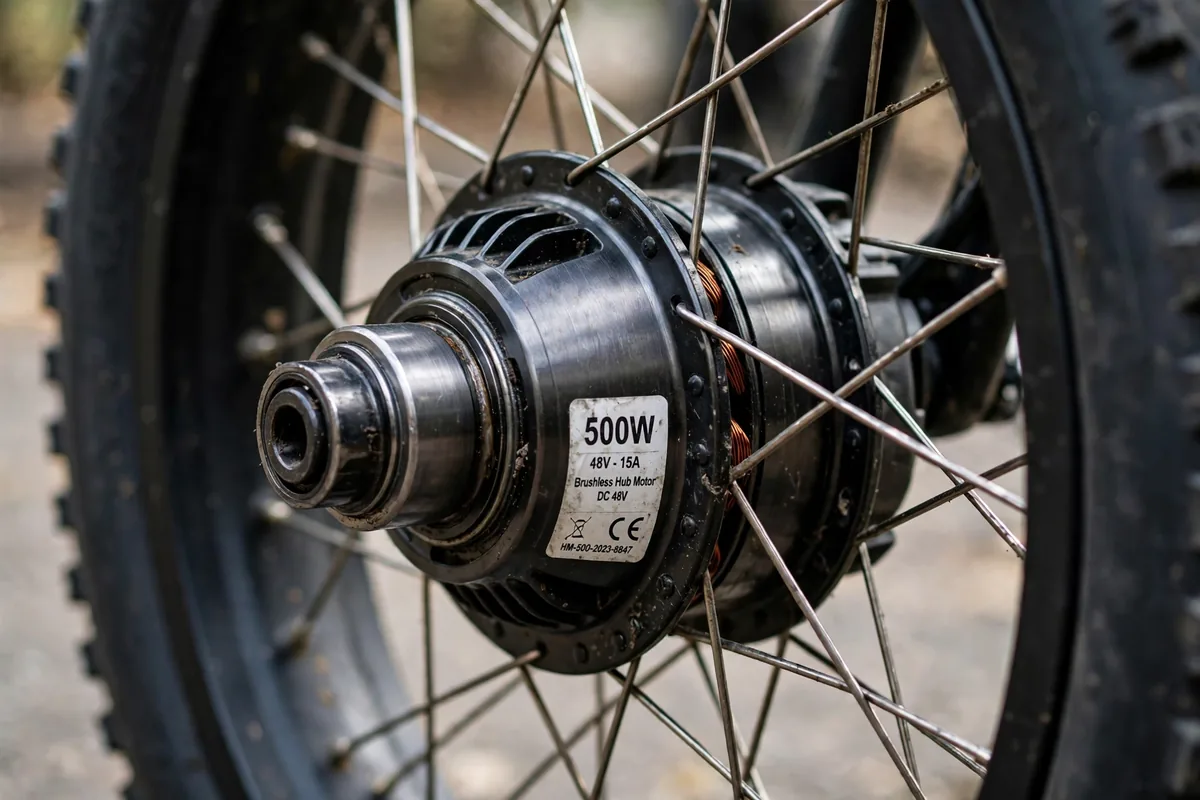
Check the motor’s own engraved or printed label, ask whether the figure is rated or peak power, and take a test ride with your typical load. A genuine rating survives all three checks.
Conclusion
Motor power is about matching muscle to workload: 1000W for the calm solo city rider, 1500W for the everyday commuter with passengers and mixed roads, and 2000W for hills, weight and work. Judge the motor together with its controller and battery, keep range in the same calculation, and the biggest number on the showroom poster will stop deciding for you.