
Choosing among the best e bikes for students Pakistan showrooms offer is less about finding one “top model” and more about matching a bike to your actual student life: how far your campus is, where you will charge, and what your monthly budget can carry. A bike that is perfect for a hostel student riding 8 km a day is wrong for a day scholar commuting 35 km each way. This guide gives you the selection method, the realistic range and budget bands, and the checks to run in the showroom — so whether you buy through a scheme or with your own money, you end up with the right bike.
Prices in Pakistan change often with the dollar rate and dealer stock. Price bands below are examples to plan around — always confirm the current price, battery replacement cost and warranty terms in writing before paying.
Start With Your Real Daily Distance
Write down your honest round trip: home or hostel to campus, plus the evening run to the academy, market or part-time job. Then add a safety margin and pick a bike whose realistic range beats that number comfortably. A useful rule: treat the advertised range as an ideal figure achieved by a light rider at steady speed, and expect roughly 20–30 percent less in stop-and-go city traffic with a passenger or a heavy bag. If your daily need is 40 km, shortlist bikes honestly rated around 60 km or more per charge, so the battery is not emptied daily — shallower daily use also makes the battery last longer.
If your institute is recognised under a scheme, the bike may be chosen for you from an approved list; your job then is to check that the allotted model’s range fits your route, which you can review alongside the E Bike Scheme for Students details.
The Three Student Budget Bands
| Band (example prices) | Typical battery | Realistic range | Best for |
|---|---|---|---|
| Budget campus bikes | Lead-acid or small lithium | 40–60 km | Short hostel-to-campus rides, low purchase price |
| Mid-range daily commuters | 72V lithium, ~20Ah | 60–85 km | Most day scholars; best balance of price and life |
| Long-range models | Larger lithium, 30Ah+ | 90–120 km | Long commutes, riders also doing deliveries |
Band prices move with the market, so use the bands as relative steps, not fixed rupee promises: budget models may cost noticeably less upfront, but a lead-acid battery usually needs replacement sooner, narrowing the saving. The mid-range lithium band is where most students get the best value per year of service.
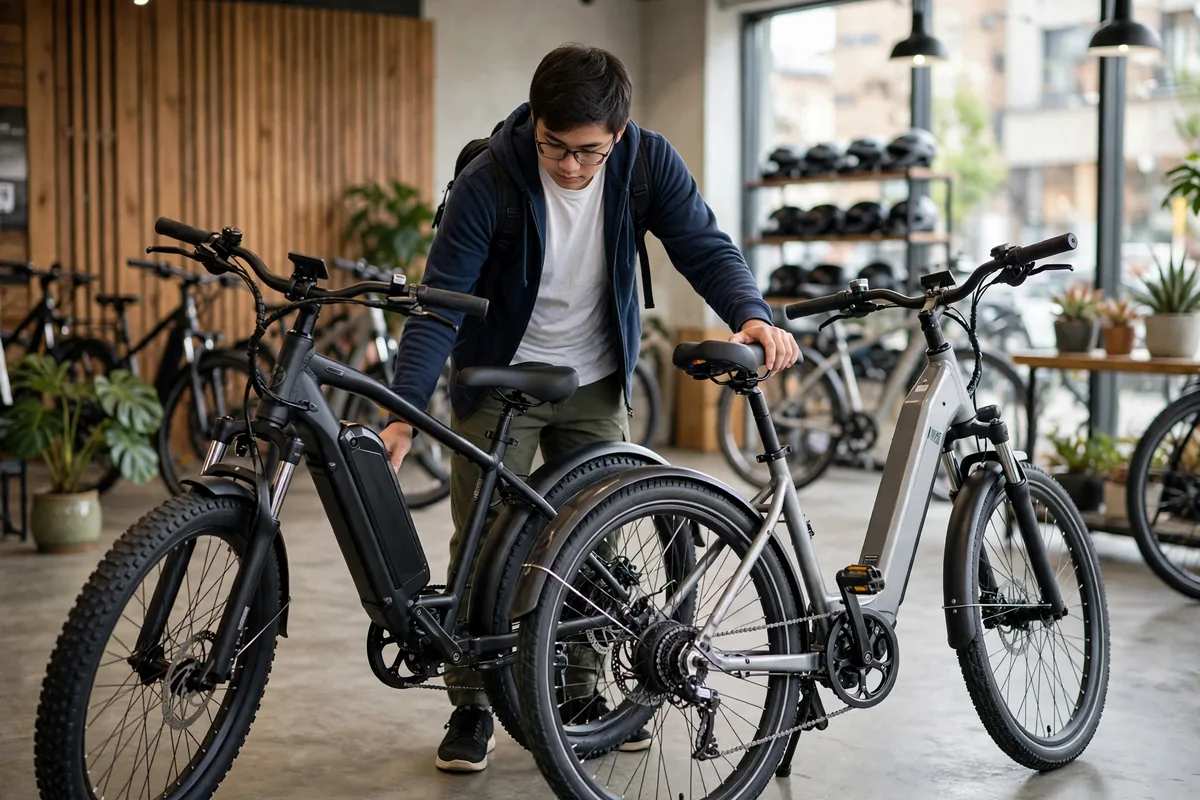
Best E Bikes for Students Pakistan: Features That Actually Matter
- Removable battery: the single most student-friendly feature. Hostel and flat residents can carry the pack indoors to charge instead of hunting for a ground-floor socket.
- Battery type and warranty: prefer lithium with a written warranty period and a clearly stated replacement price. Ask both questions in the showroom, out loud.
- Charging time: a 5–7 hour full charge fits an overnight routine; much longer breaks a student’s schedule.
- Load and comfort: check seat space for a second rider occasionally, a strong rear carrier for your bag, and suspension that survives your actual roads.
- Local parts and service: the best bike is the one your city’s mechanics can repair. Prefer brands with a service point in your city and common tyre and brake sizes.
- Brakes and tyres: at least a front disc brake and decent tread; you will ride in monsoon eventually.
Scheme Bike or Showroom Bike?
For an eligible student, a scheme bike usually wins on cash flow: installments replace a large upfront payment, and the model offered is typically a sensible mid-range commuter. You can line up your documents through the Apply process while comparing. A showroom purchase wins on choice — you pick the exact range, battery and colour — and on speed if scheme phases are closed. Either way, run the same showroom checks. Also make sure your institute is a recognised one; students can confirm institutional recognition through the Higher Education Commission listings when a scheme asks for it.
Five-minute showroom test
- Sit on the bike with your usual bag; check reach, seat height and stand stability.
- Ask for a short test ride including one slope and one U-turn.
- Photograph the battery label — volts, amp-hours, brand — for your records.
- Confirm the charger type and whether a spare charger is available locally.
- Get warranty terms and battery replacement price written on the invoice or quotation.
FAQs
How much range does a student really need?
Most students need 40–70 km of realistic daily range. Measure your round trip honestly, then buy about one-third more rated range than that to cover detours and battery ageing.
Is a removable battery important for hostel students?
Yes, it is often the deciding feature. Hostels rarely allow parking-floor charging, so a pack you can charge in your room — with the hostel’s permission and a safe socket — makes daily use practical.
Should I choose lithium or lead-acid on a tight budget?
Lead-acid lowers the purchase price but usually needs earlier replacement and gives less range per kilogram. If your daily distance is short and budget is strict it can work; for daily long commutes, lithium is better value over the degree’s full length.
Can a student handle the installment plus charging cost?
Charging is a small monthly amount compared with petrol savings, so many students find the installment is largely offset by not buying fuel. Still, budget honestly for the full tenure, including a battery savings share in later years.
What if the scheme allots me a model I did not choose?
Check its real range and battery type against your route before accepting delivery. If it genuinely cannot cover your daily distance, ask the scheme help channel about alternatives within the approved list rather than refusing without a record.
Conclusion
The best e bikes for students in Pakistan are not the flashiest in the showroom — they are the ones whose honest range covers your real day, whose battery you can charge where you live and afford to replace one day, and whose parts your city can service. Measure your route, favour the mid-range lithium band if you can, test-ride before deciding, and your bike will quietly save you money from orientation week to graduation.